How SUS code is compiled
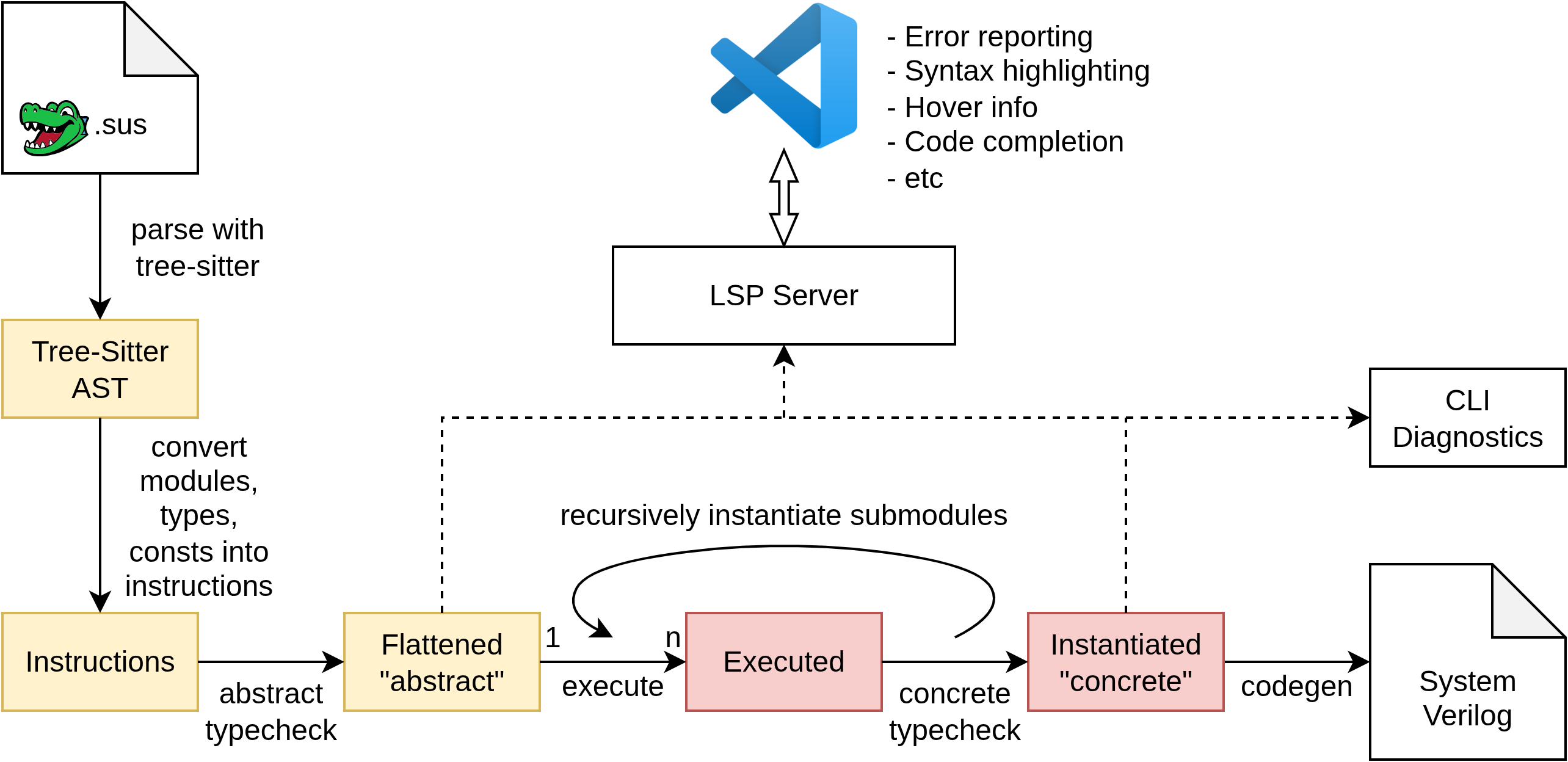
There are five major "stages" in the SUS compiler:
Parsing
Parsing is done using tree-sitter. Tree-Sitter was chosen due to its fast parse times and error tolerance. It generates an untyped syntax tree, with ERROR nodes representing invalid syntax. These error nodes are converted to diagnostics to let the programmer know what's up.
Flattening
The untyped syntax tree is then converted to a "flattened" variant. This is basically a sequence of instructions for compile-time execution. This list of instructions is still untuy
In this example, we'll look at a ToOneHot module, shown below.
module ToOneHot#(int SIZE) {
  input int#(FROM: 0, TO: SIZE) idx
  output bool[SIZE] bits

  for int i in 0..5 {
    bits[i] = idx == i
  }
}
During parsing and flattening, the above module is turned into a sequence of instructions. Something roughly like:
$0: Declaration("SIZE", GenerativeParameter, "int", ...)
$2: Expression(IntConstant(0, ...))
$1: Expression(VarRead("SIZE", ...))
$3: Declaration("idx", Wire, "int#(FROM: $1, TO: $2)", ...)
$4: Expression(VarRead("SIZE", ...))
$5: Expression(IntConstant(0, ...))
$6: Expression(IntConstant(5, ...))
$7: Declaration("i", Generative, "int", ...)
$8: ForLoop(in: $7, from: $7, to: $8, body: $9-$13)
$9: Expression(VarRead("i", ...))
$10: Expression(VarRead("idx", ...))
$11: Expression(VarRead("i", ...))
$12: Expression(Operator($10, "==", $11, ...))
$13: Assign("bits[$9]", $12, ...)
Abstract Typechecking
All declared modules, structs, consts go through the abstract typing stage exactly once. During abstract typechecking stage, global names are resolved, module ports and struct fields are resolved, it is checked that rumtime values aren't passed to compiletime contexts, clock domains are assigned and checked for conflicts, and light typechecking (ensures int is not passed to a function requiring a bool for instance, but bounds aren't checked yet). Its main task is to catch all errors that can be caught, before concrete values are known for the object's Parameters.
In the ToOneHot module, the compiler finds no abstract typing errors, so we it is now ready for execution.
Execution
After the ToOneHot has been abstract-typechecked, it may be instantiated with some concrete arguments. In this case we chose ToOneHot#(SIZE: 5). The SUS compiler acts much like a simple imperative interpreter. Using loops and if statements as control flow, altering compile-time variables as written. When when statements, or other runtime statements like assigns and submodule instantiations are encountered, they are converted to wires/submodules to be included in the final design. Importantly, the types of these wires & submodules does not have to be fully known at execution time. Full resolution of these types and the instantiation of submodules only happens during Concrete Typechecking.
After executing all the compile-time code, we are left with a module that effectively looks like:
module ToOneHot_SIZE_5 {
  input int#(FROM: 0, TO: 5) idx
  output bool[5] bits

  bits[0] = idx == 0
  bits[1] = idx == 1
  bits[2] = idx == 2
  bits[3] = idx == 3
  bits[4] = idx == 4
}

During execution, errors may crop up, such as array index out of bounds errors, divide by zero, etc. These immediately halt execution.
Note: Since you can execute arbitrary code at compiletime, compilation may take arbitrarily long or even hang forever if an infinite loop is created.
Concrete Typechecking
If after execution no errors came up, the instantiated module proceeds to the final stage. Here, any concrete values that cannot be generically checked from the abstract representation are checked or inferred. The bounds of integers, array sizes, and parameters of submodules are checked or inferred. When all of a submodule's parameters become known, it is instantiated recursively.
Let's say we've got another module:
module OneHotPlusOne {
  input int#(FROM: 0, TO: 4) idx
  output bool[] bits

  int idx_plus_one = idx + 1

  ToOneHot toh

  toh.idx = idx_plus_one
  bits = toh.bits
}
The bounds of idx_plus_one are inferred:
module OneHotPlusOne {
  input int#(FROM: 0, TO: 4) idx
  output bool[] bits

  int#(FROM: 1, TO: 5) idx_plus_one = idx + 1

  ToOneHot toh

  toh.idx = idx_plus_one
  bits = toh.bits
}
From this, the SIZE parameter of toh is inferred:
module OneHotPlusOne {
  input int#(FROM: 0, TO: 4) idx
  output bool[] bits

  int#(FROM: 1, TO: 5) idx_plus_one = idx + 1    // *

  ToOneHot#(SIZE: 5) toh

  toh.idx = idx_plus_one
  bits = toh.bits
}
ToOneHot#(SIZE: 5) is instantiated as ToOneHot_SIZE_5, and since its output port output bool[5] bits has a known size, we infer that our bits output should also have size 5:
module OneHotPlusOne {
  input int#(FROM: 0, TO: 4) idx
  output bool[5] bits                            // *

  int#(FROM: 1, TO: 5) idx_plus_one = idx + 1

  ToOneHot_SIZE_5 toh                            // *

  toh.idx = idx_plus_one
  bits = toh.bits
}
Finally, although we didn't cover it in this section, Latency Counting occurs here too.